
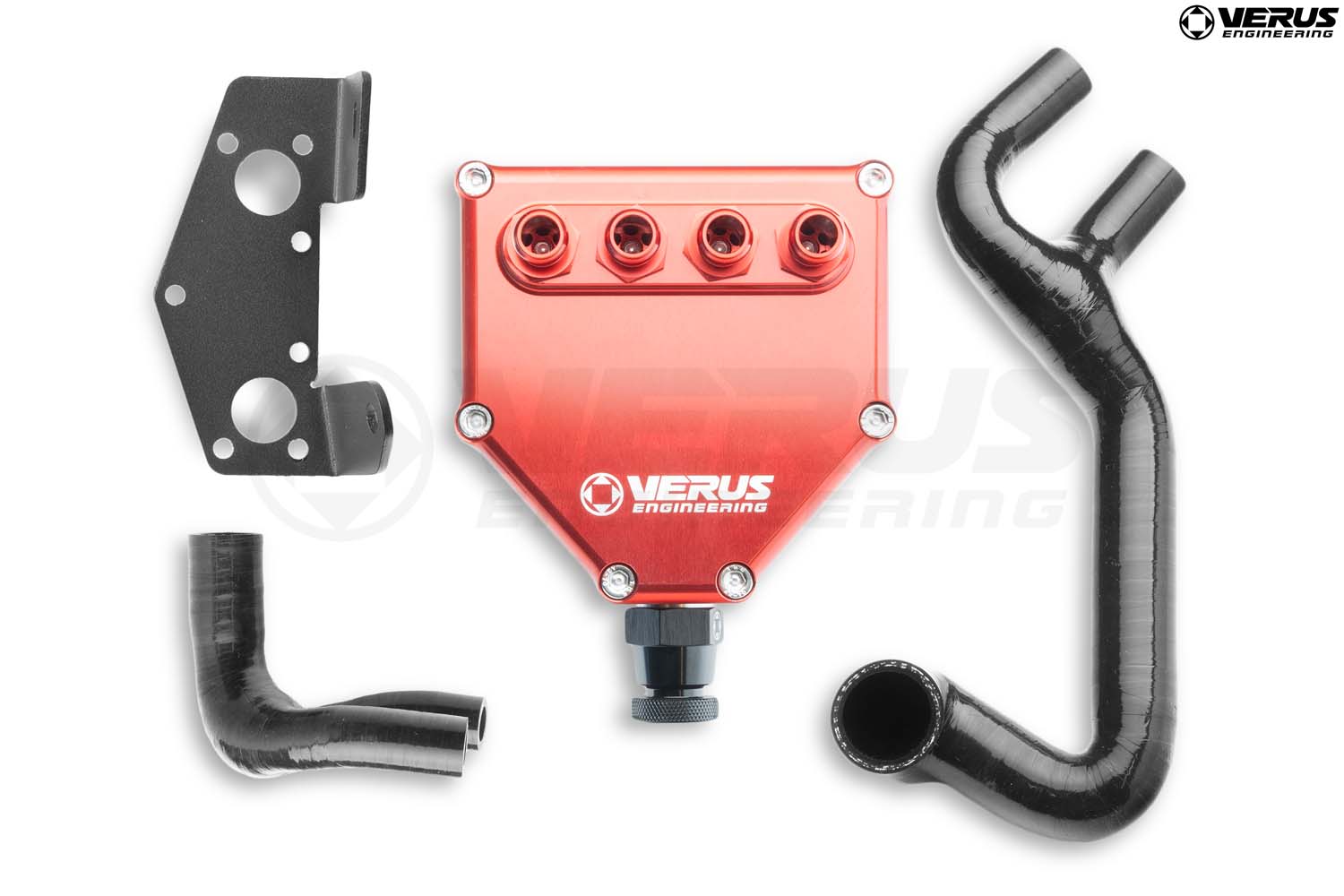
Verus Engineering Air-Oil Separator (AOS) #A0228A – 2020-2025 Toyota GR Supra A90 (B58 3.0T)
- Description
Verus Engineering Air-Oil Separator for the A90 Supra — The Catch Can Every Tuned B58 Actually Needs
The 2020+ Toyota GR Supra A90's B58 engine runs a direct-injection combustion cycle with a PCV system that continuously pushes oil vapor into the intake tract. On a stock car it's a slow build-up. On a tuned car — MHD, bootmod3, Ecutek, any Stage 1 or higher map — the vapor volume increases sharply, coats the intake valves in carbon, and eventually costs you drivability and power. The Verus Engineering AOS is the enthusiast-preferred solution: a track-proven air/oil separator that catches PCV vapor before it reaches the intake, drains through a serviceable reservoir, and installs without cutting or modifying a single OEM component. It's the mod every B58 forum thread eventually recommends.
Why Direct-Injected B58s Need a Real Catch Can
The B58 has no port injection to wash the back of the intake valves. Every PCV cycle carries oil mist from the crankcase through the intake tract; the mist plates onto hot valve stems and bakes into carbon. Over 40–60k miles the buildup restricts airflow, causes cold-start rough idle, misfires, and measurable power loss.
A tune accelerates this by increasing crankcase pressure and blow-by volume. What was a 60k mile problem on a stock car becomes a 25–30k mile problem on a Stage 2 car.
Cheap "engine bay ornament" catch cans without proper baffling and drainage don't actually separate the vapor — they just add an inline restriction. Verus's AOS uses a real baffled internal chamber, coalescing media, and a serviceable drain, so oil actually collects instead of passing through. Every B58 tuning shop that has torn down a customer engine for a valve walnut-blast will tell you the same thing.
What Changed vs. OEM PCV System
- Vented, baffled AOS chamber — real internal separation with coalescing media, not a hollow can.
- Serviceable drain valve — visible sight-glass reservoir, easy to check and drain.
- Direct-fit hardline routing — no rubber hose kludges, proper AN fittings.
- Retains OEM PCV valve behavior — doesn't disable emissions systems, doesn't throw codes on stock or tuned ECU.
- Mounts using factory bolt holes — no drilling, no chassis modification, fully reversible.
- Anodized 6061 aluminum construction — corrosion-resistant, motorsport-durable.
Verified Real-World Results
| Mileage / Use | Oil Collected (typical) | Intake Valve Condition (comparison) |
|---|---|---|
| 5,000 street miles, stock tune | 0.5–1.0 oz | Meaningfully cleaner than no-can B58 |
| 5,000 street miles, Stage 2 | 1.5–3.0 oz | Dramatically cleaner — no visible carbon build-up |
| 1 track weekend (4 sessions) | 0.3–0.8 oz | Prevents peak-load blowby fouling |
| 40,000 mile teardown, Verus AOS installed since 5k | ~20 oz cumulative | Valves look like stock at same mileage without AOS look at 15k |
Data compiled from Verus published dyno cell testing, SupraMKV forum long-term reports, and Kinetic teardown observations. Actual oil catch varies with driving style, tune aggressiveness, and PCV cycle frequency.
Full Specifications
- SKU: A0228A-BLU (blue anodized)
- Material: 6061-T6 aluminum, anodized
- Chamber design: Baffled with coalescing media
- Drain: Serviceable valve with sight glass
- Fittings: AN-style, direct-fit hardline
- PCV compatibility: Retains OEM valve behavior — no CEL
- Emissions: Does not disable emissions equipment; catch can only
- Mounting: Factory bolt holes, no modification required
Fitment
Fits:
- 2020–2025 Toyota GR Supra A90 3.0 (B58 3.0T engine)
Does NOT fit:
- A91 Supra 2.0 (B48 — separate Verus AOS part number for B48)
- BMW G-chassis B58 (M340i, M440i, Z4 M40i — different bracket geometry)
- Pre-2020 vehicles
What's In the Box
- Verus AOS assembly (anodized 6061 aluminum, blue)
- Mounting bracket, direct-fit for A90 chassis
- AN-fitting hardlines (inlet, outlet)
- Hardware pack (bolts, gaskets, sealing washers)
- Installation instructions
Install Notes (Real Gotchas)
- Budget 2–3 hours in the driveway. This is not a "20 minute install." Routing the hardlines cleanly and getting the bracket to sit right takes patience.
- Support the intake tract during removal. Don't put lateral stress on the OEM PCV nipple — it's a cast-in-place feature and cracking it means a new valve cover.
- Use a small dab of Loctite on the AN fittings. Not thread sealant — Loctite blue. Vibration on the B58 loosens un-torqued fittings.
- Drain regularly at first. Every 500 miles for the first 5,000 to calibrate how much your car produces. After that, every oil change interval is fine.
- Cold-weather ops: Empty the can before storage. Water condensation in the AOS reservoir can freeze and block flow.
- No tune change required. The AOS is transparent to the ECU — no calibration, no code faults.
Do You Actually Need This?
| Your setup | Should you buy? | Why |
|---|---|---|
| Bone stock, low miles | Optional | Nice long-term protection but not urgent under 20k miles. |
| Stage 1 or 2 tune | Yes | Blow-by volume is higher — carbon buildup accelerates without a can. |
| E85 / E30 blend | Required | Higher fuel wash and blow-by volume make an AOS non-negotiable. |
| Track / autocross | Yes | Sustained WOT loads maximize PCV vapor. Cheap insurance. |
| Already have a "bling" catch can with no baffling | Replace it | Non-baffled cans don't actually catch oil. You're not protected. |
FAQ
Will this throw a CEL?
No. The Verus AOS retains OEM PCV valve behavior and doesn't interrupt any emissions sensors. Works on stock or tuned ECU.
How often do I need to drain it?
Check every 500 miles at first. On a Stage 2 street car, you'll drain 1–3 oz per 5,000 miles. On track duty, check after each event.
Verus vs. Mishimoto vs. Radium vs. KLM — which is best?
All four are legitimately baffled AOS designs. Verus has the cleanest installation, the most forum long-term data, and the strongest reputation on the B58 platform specifically. Radium is close on quality. Mishimoto is the value pick. KLM is race-focused. For a street/track Supra, Verus is the balanced answer.
Does it affect PCV pressure or engine breathing?
No. The AOS is a vented pass-through with proper flow — the crankcase sees the same PCV vacuum as OEM.
Will it prevent all intake valve carbon?
Nothing prevents 100% — it dramatically reduces the rate. You will still eventually want a walnut blast, but at 60k+ miles instead of 25–30k.
Can I install this myself?
Yes, if you're comfortable working on the intake tract. Budget 2–3 hours and take your time on the hardline routing.
Kinetic Install & Walnut-Blast Service
Kinetic Autoworks installs the Verus AOS as a standalone service or bundled with a walnut-blast intake-valve cleaning if you're catching this at higher mileage. We route hardlines cleanly, torque all AN fittings to spec, and confirm no leaks under a smoke test. If your A90 is over 30k miles and never had a catch can, do both services in one visit — contact us or call the shop.